The Superpower Every School Leader Needs
I’m not a movie buff by any stretch, but I pay attention to what my kids watch. In Encanto (2021), Dolores hears whispered doubts and unspoken truths everyone else misses. In Turning Red (2022), Mei’s mother sees through the “everything’s fine” facade. In The Batman (2022), Batman’s strength lies in seeing patterns and motivations invisible to everyone else. But the most powerful example isn’t fictional. Bill Campbell, a former college football coach from Pennsylvania, became the “Trillion Dollar Coach” by mentoring Steve Jobs, Larry Page, Eric Schmidt, and Sheryl Sandberg. His gift wasn’t technical expertise. It was seeing beyond surface performance to what was really holding people back. Like our fictional heroes, Coach Campbell had X-ray vision for human potential. As school leaders, we need to share this same vision with our teaching staff. We too often accept surface-level performance without recognizing hidden barriers. The “consistent” teacher who seems reliable might be trapped by a “good enough” mindset. The “committed” teacher working tirelessly could be hitting a ceiling because impostor syndrome prevents leadership growth.
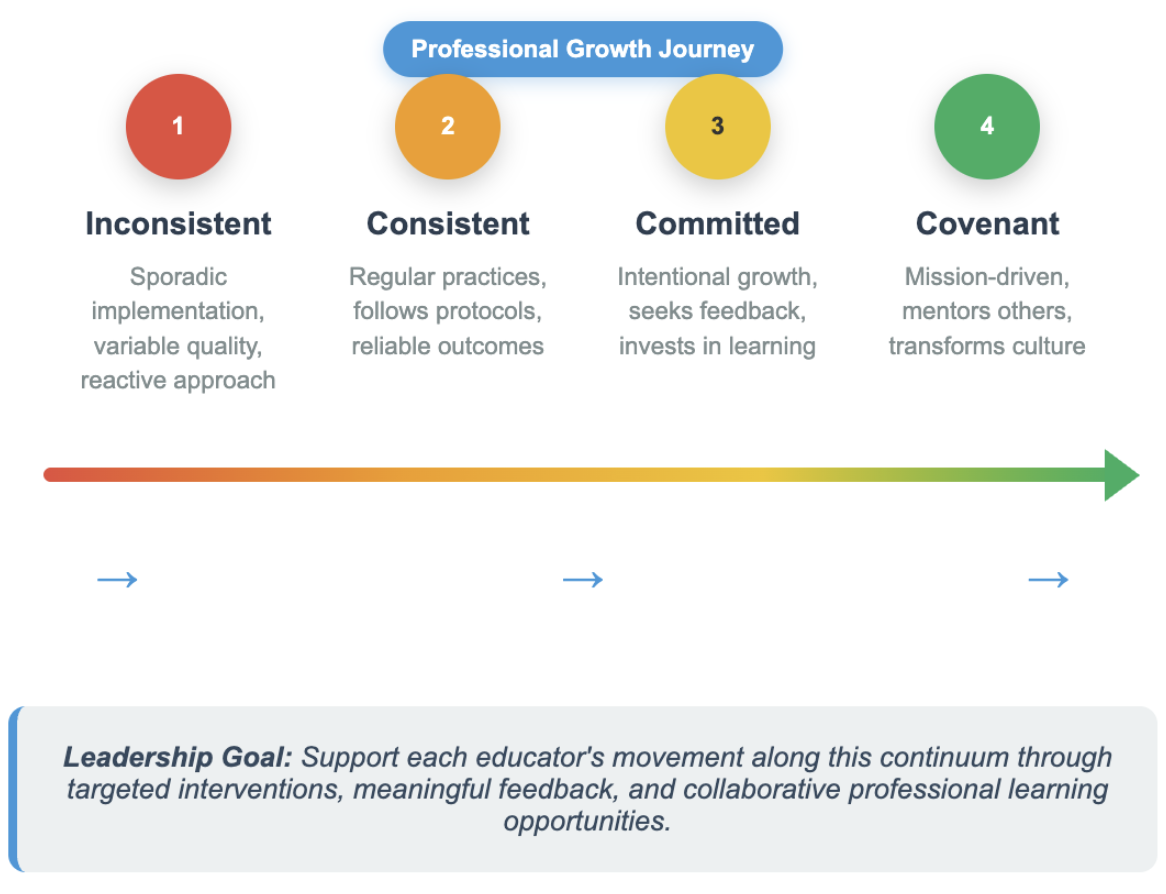
The most dangerous phrase in school leadership is “They seem fine.” “Fine” is where excellence dies. Our students deserve exceptional education. “Fine” isn’t good enough. This is Part 1 of a four-part series exploring a Teacher Performance Continuum, providing insight into building and sustaining an elite teaching culture.
Identifying the Inconsistent Teacher
Teachers at this level exhibit sporadic approaches with little structure or clear systems. Their default is reactionary, making them unpredictable from week to week. Performance quality varies dramatically, classroom management fluctuates, assessment practices are irregular, parent communication is inconsistent, and professional responsibilities are sometimes overlooked.
Like Bill Campbell sizing up key players in iconic companies, you need not observe every behavior. Look for patterns. I once worked with a colleague who seemed to have two personalities. This teacher coached three sports, was heavily involved in the community, and even led one of the school’s extracurricular clubs. It was seemingly Herculean. However, every time I passed this teacher’s classroom, there they were, on their phone. At the same time, students mindlessly watched concept videos and completed online assignments to achieve some mythical benchmark of completion.
A few times, I even covered the class in the teacher’s absence. Upon talking with the students, the patterns became clear. The two biggest indicators were day-to-day planning and a “that’s the way I’ve done it” mentality—the classic “if it ain’t broke, don’t fix it” defense. However, this teacher was blind to a truth the students could have told you: the system, or lack thereof, was broken. There was little learning, just existing.
What Really Holds Them Back
Root causes typically include a lack of clear expectations, insufficient training or support, and personal stress or life challenges. But the invisible barriers run deeper: a “Survival Mode” mindset that plans only day-to-day, a blame-first mentality that attributes problems to others rather than examining one’s own practice, change avoidance rooted in the notion that “this is how I’ve always done it,” and a quick-fix seeking that expects immediate solutions without sustained effort.
These hidden barriers are why surface-level interventions fail. We must address the underlying mindset, not just visible symptoms.
Creating Momentum: Moving from Inconsistent to Consistent
Dig Down to the Root
Last summer, I needed a root canal. After the consult, I left oddly at ease. My endodontist explained the process thoroughly, accounting for the challenges my specific tooth posed and her plan for each scenario. During the two-hour procedure, I was fascinated by her ability to drill down from four different entry points, meticulously adjusting tools and approach along the way.
Confronting an inconsistent teacher requires the same precision. We must identify and address root causes while providing structured, sustained support. Be patient: Two hours in a dental chair equals 3-6 months in a school year. This isn’t a quick-fix phase.
Target the hidden sticking points first. Address survival mode by helping create weekly and monthly planning systems, not just daily plans. Shift blame to ownership with coaching questions like “What’s one thing within your control that might help?” Make change feel safe by starting with tiny modifications to existing practices rather than complete overhauls. Combat quick-fix thinking by setting realistic timelines and celebrating incremental progress.
Establish Clear Expectations and Systems
Create structured accountability through written protocols, planning templates, and clear assessment requirements. Provide observation and feedback cycles with agreed-upon schedules and follow-up conferences within 24-48 hours. Never underestimate the power of 5-10 minute walkthrough observations with specific, actionable feedback focused on one improvement area at a time.
Assign Strategic Support
Pair with a mentor teacher who models effective systems. Move from evaluative to coaching stance with frequent, specific feedback. Provide planning time, curriculum materials, or technology support that removes barriers to success.
I remember my own inconsistency early in my teaching career. Luckily, I had a mentor who provided exactly this kind of frequent, specific feedback. Not only did she make powerful, brief observations, but our almost-daily dialogue was uplifting and encouraging. Admittedly, I had to stay humble enough to realize there was much to be learned in the profession—the room for growth is always revealing itself.
One specific breakthrough came when I was asked to take over her Advanced Placement Calculus class during her maternity leave. Only because I had made significant progress in lesson planning and assessment design, with my mentor’s guidance, was I confident enough to accept such an assignment. The systems I had put in place, from pre-assessments to team building, could now take center stage.
That single moment of entrustment with an AP class became a pivot point in my career. It sparked a passion that eventually led me to write AP Calculus textbooks and speak at national AP conferences, none of which I can take credit for alone. That mentorship didn’t just improve my teaching that semester; it set a trajectory I’m still following today. This is what’s at stake when we invest deeply in inconsistent teachers: not just better lessons tomorrow, but transformed careers and compounded impact for years to come.
Moving inconsistent teachers requires a delicate balance. Too much empathy without accountability enables stagnation. Too much accountability without empathy breeds resentment. The formula: understand their struggles and provide resources (empathy), maintain clear standards and timelines (expectation), and ensure consistent follow-through with honest conversations (accountability). This balance creates psychological safety while maintaining high standards and serves as a foundation for genuine growth.
With intensive, targeted support, expect 3-6 months before seeing sustainable consistency.
What Success Looks Like
You’ll know an inconsistent teacher is moving toward consistency when daily routines become established and predictable, lesson plans are complete and submitted on time, classroom management stabilizes, professional responsibilities are consistently fulfilled, and they begin asking for feedback rather than avoiding it. These indicators signal readiness for the next level of growth.
Looking Ahead: Part 2
Once teachers achieve consistency, a new challenge emerges: the comfortable plateau. In Part 2, we’ll explore the CONSISTENT teacher. You know them as those reliable educators who meet expectations but struggle to exceed them. We’ll uncover the “Good Enough” syndrome and strategies to ignite the spark that moves them toward COMMITMENT.
The journey from stuck to stellar continues.