Part 2: Moving the Consistent Teacher Toward Commitment
A Quick Look Back
Part 1 exposed the invisible barriers holding inconsistent teachers back: the “survival mode” mindset, blame-first mentality, and “this is how I’ve always done it” resistance that no amount of professional development can fix. We learned that moving these teachers toward consistency requires X-ray vision to see beneath surface performance and the leadership courage to address uncomfortable truths. The payoff is a teacher who moves from reactive chaos to predictable excellence, ready for greater challenges ahead. But here’s where it gets tricky. Once teachers achieve consistency, a new trap emerges: the comfort plateau. Spotting it requires an entirely different kind of X-ray vision.
Identifying the Consistent Teacher
Tell me without telling me you know a teacher like this. In every school I’ve taught in, for nearly 30 years now, there continue to be multiple teachers like this. I started teaching in the 90s. It’s now 2026. You do the math on whether this is acceptable. Picture this: I’ve been teaching for 10 years. My lesson plans are always on time. My lessons seem to be landing like a finely tuned machine. My class expectations are clear, and classroom management is buttoned up. I am at every faculty and department meeting. My AP students are passing the AP Calculus exam at about an 80% rate. I am seemingly exactly where I think I should be, professionally.
If you are paying attention, you will realize that everything I just said is the problem. I became like my favorite college cover band. They play the same setlist flawlessly every night. The notes are perfect, the timing is precise, but there’s no creativity, no growth, no original music. They’ve mastered reproduction but lost the ability to create. The one thing I’ve learned in my own journey is that “Consistency without quality is just rehearsed failure.”
What couldn’t I see? Well, if my 2007 AP scores were any indication, I should have seen it coming. That year, I only had a 60% pass rate. My students were compliant but not engaged, able to memorize anything but understand nothing. My lesson structure was nearly identical year after year, never accounting for the different students sitting in front of me. I had stopped creating or innovating and started simply routinizing, and not just in my AP classes. All my classes looked this way.
What Really Holds The Consistent Teacher Back
The consistent teacher appears successful by every traditional metric. But beneath that reliable surface, powerful hidden barriers prevent breakthrough to true excellence, such as:
- “Good Enough” Syndrome: Consistent teachers have confused competence with mastery. For example, my belief that an 80% AP pass rate was the end game to AP success for my students gave way to a belief that meeting minimum standards equals excellence. Why push for 95%?
- Comfort Zone Addiction: Growth requires risk, and risk creates temporary discomfort. Consistent teachers have built a system that works predictably, and the thought of disrupting it for potential improvement feels like too much effort.
- Status Quo Protection: Consistent teachers subtly resist change initiatives that might disrupt established routines. New curriculum? “Let me adapt it to what I already do.” New instructional strategy? “I’ll try it once, but I know what works for me.”
Consistent teachers are the hardest to move because they are not failing. They are succeeding at a level just high enough to avoid scrutiny but just low enough never to achieve greatness. Since everything looks orderly, we miss it for years.
The Wake-Up Call
So, did I make a change as we began the 2007-2008 school year? Heck no! Why intervene if “nothing is broken”? Had it not been for a tragic turn of events, I fear I never would have changed or grown. In the spring of 2008, education as I knew it was turned upside down. There we sat, just over a week out from this year’s AP exam, when I received a phone call from my building principal. On a Friday night. Not normal. One of my AP students had taken their own life.
Sit with that for a minute.
One of my AP students had taken their own life.
In that moment, math meant nothing. In the days, weeks, and months that followed, my routines and habits would be exposed. I would be forced to change, or confront the reality that I would never progress beyond a consistent teacher, average at best.
This is when I learned that consistency without quality is just rehearsed failure. I was a teacher who was failing students predictably, and because it looked orderly, I missed it for years. I needed to move from consistent to COMMITTED. But how?
Creating Momentum: Moving from Consistent to Committed
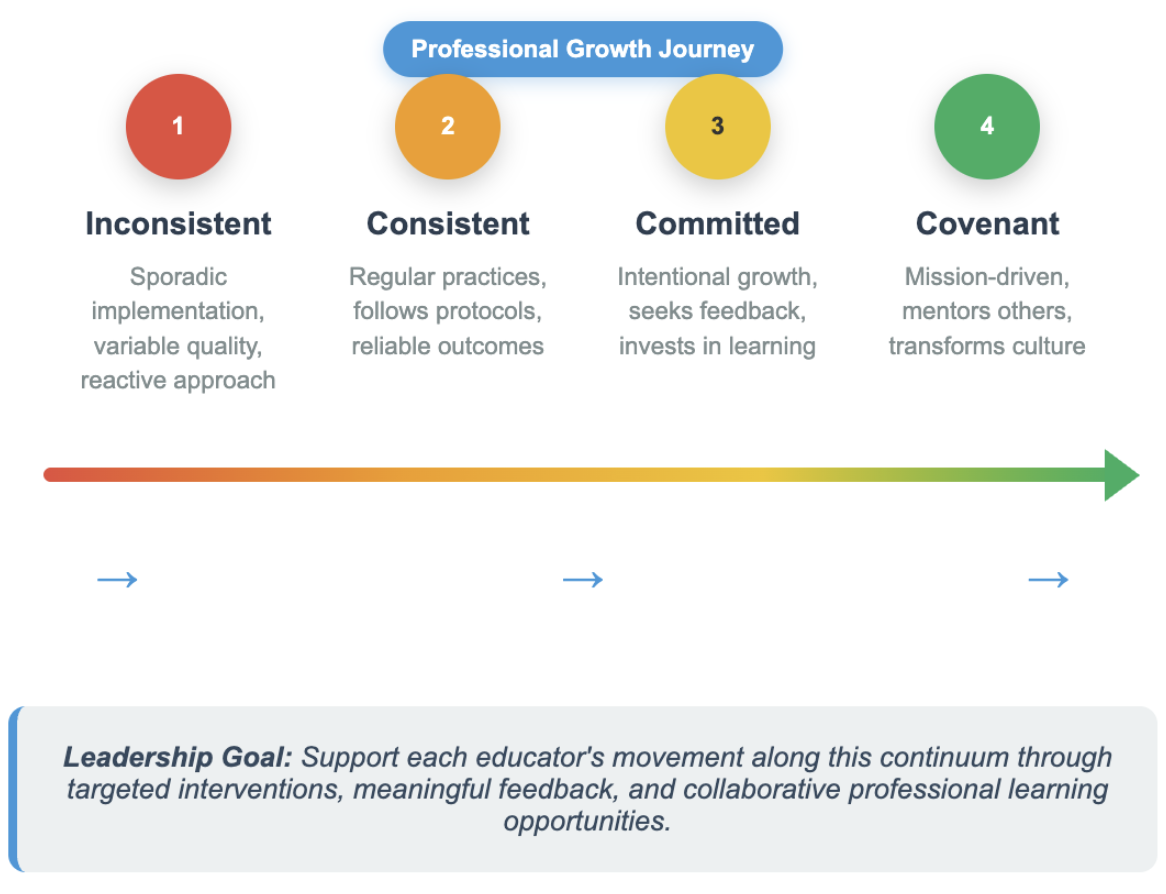
Moving consistent teachers toward commitment requires a fundamentally different approach than moving inconsistent teachers toward consistency. These teachers don’t need systems; they need disruption. They don’t need more support; they need productive discomfort. We often hear about this same dynamic with students: the need to engage in productive struggle.
Here are some actionable strategies to move consistent teachers along the continuum to a more COMMITTED teacher.
- Challenge the “Good Enough” Mindset: Show them what’s possible. Use data to reveal the gap between their current results and what students are capable of achieving. Introduce them to high-performing classrooms where teachers get breakthrough results with similar students. The goal is to expand their vision of what “good” actually looks like. Consider asking the teacher, “What would it look like if 95% of your students passed the AP exam? What would need to change?”, or “I notice your students can execute procedures well but struggle to explain their thinking. What might that tell us?”
- Create Productive Discomfort: Invite them to lead a professional learning community where they must articulate and defend their instructional choices and strategies. Encourage them to visit classrooms of teachers using different approaches. Assign them to pilot a new curriculum or strategy. The discomfort of trying something new, even temporarily, can break the spell of routine. Ideally, any opportunities that stretch the teacher require growth, from curriculum design to new teacher mentoring. These roles force the consistent teacher to articulate their practice, which often reveals gaps they hadn’t noticed.
- Reframe Risk as Growth: Consistent teachers avoid risk because they fear failure or looking incompetent in front of colleagues or students. Help them see “failure” as valuable data rather than personal inadequacy. Celebrate attempts, not just successes. Create a culture where trying something new and having it flop is seen as evidence of professional courage.
- Connect to a Larger Purpose: Help them understand how their growth directly impacts student outcomes beyond test scores. Show them the connection between their willingness to innovate and students’ ability to think critically and develop a genuine understanding, rather than surface-level compliance, or what I call “playing school.”
With intentional support and by challenging the status quo, you will see a significant shift from consistent to committed. This is not a quick fix; it’s a fundamental identity transformation.
The Breakthrough
For me, that transformation began with an unexpected challenge that forced me out of my comfortable routine. Our director of guidance came to me one day asking for a favor. He explained that one of our highly recruited athletes was struggling to achieve a certain score on her SAT. He said, “If I give you the data from her past tests and math classes, do you think you can help her? I know this is coming out of the blue, but are you up for the challenge? You’d really be doing us a favor.”
BOOM! There it was, a challenge that presented itself as a professional opportunity, and perhaps a risky one at that. If I were successful in helping the student, she would attain the necessary score, and I would be recognized as the one who played a part in helping her achieve that score. If the student did not earn the score she needed, then I would also be tied to her failure. Here was a chance to grow and improve my own practice. I would be forced to sit with a student whom I had never taught and barely knew. I wouldn’t have access to all those critical, intangible classroom data points, such as personality, grit, prerequisite knowledge, curiosity, and many more. What other choice did I have but to go “all in” and gather this data as quickly as I could every time we met? In doing so, I learned the value of knowing your students more than your content. That single insight transformed everything. I took that lesson into all my classes immediately, especially my future AP classes. My pass rates climbed. More importantly, my students were finally engaged, asking questions, making connections, and thinking critically rather than just memorizing procedures. I have to thank that administrator because he allowed me to be a part of a larger purpose, one where my own growth could directly impact a student outcome. He gave me the productive discomfort I needed to break out of my comfortable routine.
What Success Looks Like
You’ll know a consistent teacher is moving toward commitment when they start seeking optional professional development, asking for specific feedback on their teaching, experimenting with new instructional strategies without being asked, analyzing student data to inform practice, and collaborating with colleagues on best practices. Most importantly, they stop defending their current practice and start questioning it. These indicators signal a fundamental shift in professional identity. They’re no longer just showing up to do a job; they’re actively investing in becoming better at their craft.
Looking Ahead: Part 3
Once teachers achieve commitment, they face yet another challenge: channeling that growth energy into sustainable leadership. In Part 3, we’ll explore the COMMITTED teacher and the invisible barrier that keeps them from becoming COVENANT-level educators. We’ll uncover impostor syndrome, recognition dependency, and the leadership hesitancy that prevents breakthrough impact.
The journey from stuck to stellar continues.